|
Odd as it may sound, the Cotswold Lion is a sheep and it is the reason why people visit the Cotswolds, though they may not know it. They don't come to stare at sheep of course, but when visiting this lovely part of England they are perhaps, unaware that wool manufacture and its subsequent decline left us with a living history of farms and cottages, market towns and villages.
Here in the Cotswolds the Romans developed sheep farming on their big estates 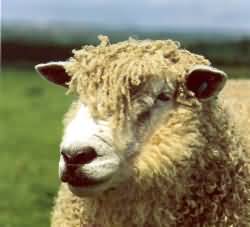 around Cirencester. They were perhaps building on methods and techniques learnt from the Celtic Britons. It is probable that in Roman Britain the sheep were smaller and therefore produced less wool. During Anglo Saxon times sheep farming continued to thrive and it's interesting to note that the words Cot and Wold come from this era. The sheep were grazed in large ‘cots' or enclosures, initially in the Cutsdean area of the north Cotswolds, the enclosures were sited on the ‘ wolds ' or hills. So a literal translation of Cotswolds is ‘sheep-hills'. German visitors who call in to the tourist office are familiar with weald and wold but tell us that, to them, it means high wooded land. In early Anglo Saxon times, our hill tops were certainly more wooded than now. around Cirencester. They were perhaps building on methods and techniques learnt from the Celtic Britons. It is probable that in Roman Britain the sheep were smaller and therefore produced less wool. During Anglo Saxon times sheep farming continued to thrive and it's interesting to note that the words Cot and Wold come from this era. The sheep were grazed in large ‘cots' or enclosures, initially in the Cutsdean area of the north Cotswolds, the enclosures were sited on the ‘ wolds ' or hills. So a literal translation of Cotswolds is ‘sheep-hills'. German visitors who call in to the tourist office are familiar with weald and wold but tell us that, to them, it means high wooded land. In early Anglo Saxon times, our hill tops were certainly more wooded than now.
Following the Norman Conquest of 1066, the church was able to increase its wealth by building on the long established wool manufacturing industry. The open field system, which had been created, was able to support very large flocks over these hills and Cotswold sheep became the foundation of the English wool trade with Europe . By the 15 th century England was so dependent on wool that the Lord Chancellor's seat in the House of Lords was made of wool and came to be known as the woolsack, a reminder to their lordships of the absolute importance of wool. Besides the church, this brought great wealth to local merchants but after 1536 the church was to loose its controlling influence following the dissolution of the monasteries. Fine houses and elegant churches were built and even ordinary cottages had a beauty and permanence that makes them popular with buyers today.
Processing the wool was initially a cottage industry, but during the late 16 th century,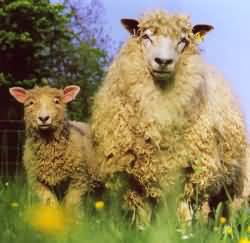 weaving became concentrated in the Stroud area where the fast flowing streams from the steep slopes of the Cotswold escarpment were better able to power the new mills. weaving became concentrated in the Stroud area where the fast flowing streams from the steep slopes of the Cotswold escarpment were better able to power the new mills.
By now the Cotswold breed was well established, being big and hornless with a white face and having a long fleece. It was prized for its high growth rate and heavy wool clip and was know to all as the Cotswold Lion.
Between 1750 and 1850 Cotswold wool production went into decline when wool output increased in the North of England where newer and more efficient forms of power were developed. With decline came poverty as the area paid dearly for an over reliance on wool. It is ironic to think that our beautiful Cotswold legacy is a result of a long period of poverty when there was little money available for further building and development. Overseas visitors have often said to me that they have in their minds eye what rural England should look like and in the Cotswolds they have found it. This is a place where time seems to have stood still and until recent times, this was quite true.
By the end of the 1914-18 war, only a few flocks of the Cotswold Lion remained and it had become a rare breed. Thanks to conservationists, who first recognised the problem, and in response to a demand for a sheep with high growth rate, the breed is expanding again. There are now more than 50 flocks, many of them in the Cotswolds and although not yet numerous as in past centuries, the breed that brought so much to this beautiful area is safe and secure.
For further information on animal husbandry and Sheepcotes see the English Heritage website. |