When I called Lords of the Manor to book the table, the French voice on the phone tactfully suggested that jeans and trainers would be inappropriate for the dining room. I couldn't agree more I'm so over jeans and trainers. A dress code that might have come across as incredibly square a year ago, suddenly sounded quite hip.
Lords of the Manor is the restaurant in the hotel of the same name in the village of Upper Slaughter, near Stow-on-the-Wold. It's the quintessence of Cotswold..........
PAINSWICK, England -- The main road through this picturesque village says a great deal about the timeless quality of the Cotswolds, a region of low, rolling hills in England's West Country.
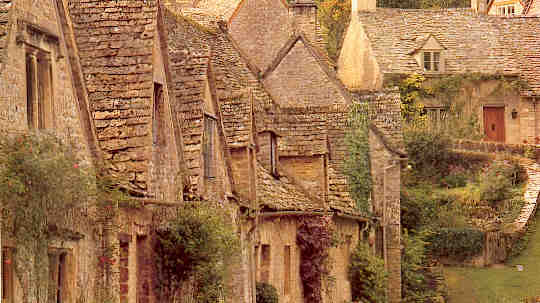
A vision of tranquil English village life, the street is lined with charming, centuries-old stone houses and a half-timbered post office that dates from the Middle Ages........
But, as food preferences evolve, Britains great puddings, even the sweet variety, were being overlooked in favor of Black Forest cake and strawberry cheesecake. In 1985, to preserve this important piece of culinary heritage, Three Ways House Hotel, a historic hotel in the low hills called the Cotswolds in the county of Gloucestershire, 90 miles from London in southwest England, established the Pudding Club. The goal: to preserve the pudding from drifting into obscurity.......
What turned out to be one of our 'funnest' trip in years, unfortunately started out in a very stressful manner. But that's life. So let me tell you how it all began:
My partner Dianne Marie and I arrived at Heathrow Airport outside London, some 13 hours after leaving San Francisco. We immediately rented a car and attempted to drive to The Cotswolds. Yes, I said "attempted," because it took us forever to get there.
ED JONES is editor of The Free Lance-Star. He can be reached at 540/374-5401 or at edjones@freelancestar.com.
GLANCE AT THE stone walls inside the little old church in Sherborne, England, and you'll notice a roster of vicars who have graced the pulpit there. The list goes back 900 years.
But it was a reference of more recent vintage that caught my eye last week as I strolled around the sanctuary. A needlepoint pad for kneeling worshippers offered a simple but touching message: "God bless America. Stand beside her, and guide her. September 11, 2001."
That evening, as my wife, Peggy, and I were watching the BBC news in our rented cottage in the Cotswolds, 75 miles west of London, we heard about a survey that found that most Britons think it's time to put distance between their country and the United States in the war on terrorism.
Those sentiments surfaced as newspapers and TV reporters swarmed around the Labor Party infighting that forced Prime Minister Tony Blair, George W. Bush's most loyal and articulate ally in the post-9/11 period, to promise to step down from office within the next year. Blair, the fresh, boyish leader of the Brits a decade ago, has become stale..........
ED JONES is editor of The Free Lance-Star. He can be reached at 540/374-5401 or at edjones@freelancestar.com
I'M NOT PROUD of it, but I might as well confess. I recently purchased my very own copy of "British History for Dummies."
Now granted, there are many areas of expertise in which I would quickly qualify as a dummy. Plumbing and cooking are two that come to mind.
But being a dummy on British history hurts.
After all, I took a course on the Tudors in college. I subscribe to The Spectator, a weekly opinion journal from Britain that keeps me on top of politics across the pond.
I once had an electronic subscription to The Times of London. I still read an array of newspapers and magazines about the Church of England.
But as my wife, Peggy, and I prepare for a short trip to the Cotswolds, that rolling slice of England three hours west of London, I still feel like a dummy............
The Royal Shakespeare Company will prove that's true.
The troupe is sponsoring a yearlong festival at Stratford-upon-Avon, William Shakespeare's hometown, at which all of the Bard's 37 plays plus his sonnets and long poems will be performed.
It will be the first time that all of the works will be presented in a single event.
The festival will open on Shakespeare's birthday, April 23, and continue into April 2007..............
After spending the better part of last month in England, walking along the River Thames, a few random observations (mostly ecologically inspired) seem in order this week. So, with a tip of the hat to author Bill Bryson, who was encountered out there in a Cotswold field, here are some of my own "notes from a long, long river.".......
ARTICLES BY RALPH GREEN FORMER ASSISTANT AT THE VISITOR INFORMATION CENTRE STOW-ON-THE-WOLD
The Cotswolds are a line of hills stretching from about 7 miles south of Stratford-upon-Avon in a south-westerly direction to Bath, a distance of 70 miles. It is bordered to the east by Banbury and Oxford and to the west by Cheltenham and Gloucester. Often described as an Area of Outstanding Natural Beauty, the largest in England and Wales. It is characterised by picturesque villages built of warm coloured limestone, sitting besides clear, fast flowing streams, set in a stunning landscape. So how did this all come about?
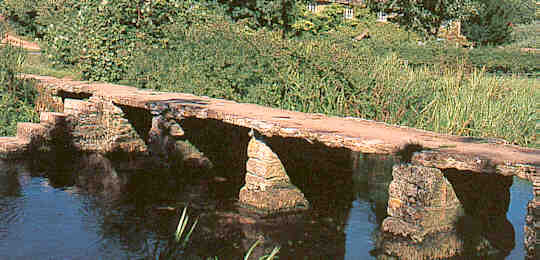
Millions of years ago a thick layer of sedimentary material was laid down to consolidate into a blue-grey coloured clay. Interspersed in the clay further deposits of silts and calcium carbonates were introduced to become layers of what we call marlstone slabs. This slab-like marlstone was quarried from early times and today can be seen providing the floors of old village pubs and ancient cottages. It was also used for making footbridges over streams and small rivers.
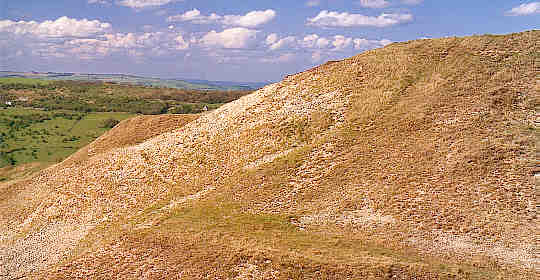
In time shallow tropical seas, rich in life covered the clay. Over millions of years, sediments derived from the shells of marine organisms and from coral were formed to give limestone. In the Cotswolds this limestone deposit is high in shell and pebble content and is known as inferior oolite. If you look very closely at limestone you will find it is made up of tiny spherical particles, called ooliths, cemented together to form a texture rather like that of fish roe. Today it is used mainly in road building and lime burning.
In some areas, a further deposit covered the limestone. These were sediments linked to volcanic activity and were rich in material containing silica. It is called fuller's earth, a greenish-grey material resembling clay and having good absorbent properties. It is said that the Knights Templars, a religious military order, living at Barton near Guiting Power in the 13th century, discovered that fuller's earth was suitable for removing the oil and grease from fleeces. The cleaning process was known as 'fulling' and contributed to the success of Cotswold wool sold in Europe. This success brought wealth and much of this wealth was used in the construction of beautiful houses and churches, which we see today.
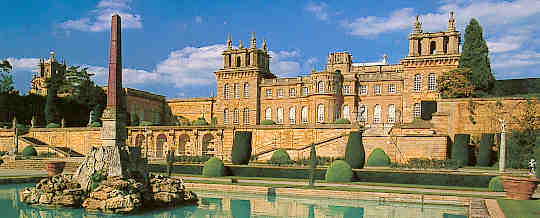
180 million years ago saw the final layer of sedimentary deposits. This is called great oolite and is a fine material free of the deposits found in inferior oolite. In its pristine condition, it must have sat like a cap on the other layers. This limestone is much sought after and was used in the construction of the Oxford Colleges, St. Pauls Cathedral, Windsor Castle, the fine buildings of Bath, in fact its use is all around us today.
All these deposits had to be turned into hills and that happened when a great movement in the earth's crust caused it all to be tilted upwards, forming an escarpment on one edge. If you travel to the Cotswolds from the west today, it is obvious that you are approaching a line of hills, the Cotswold escarpment. It is not so obvious that you are entering hills when travelling from the east. In fact, we have had visitors calling at the Information Centre in Stow-on-the-Wold asking if they have arrived in the Cotswolds yet.
A feature of the Cotswolds is the lovely valleys nearly always with a small stream or river flowing in the bottom. Now you might wonder how these shallow streams and rivers cut such deep valleys. Well they didn't, that was done by ice scouring the landscape and later, the large amount of water running from the retreating ice.
Man was the final influence in the making of the Cotswolds. It was early man who built the hill top burial mounds and hill forts, who left the marks in the earth where his medieval villages had once stood, and later still, built our present villages, using local limestone, which perfectly fit into the landscape. It is this amalgam of man and nature that has given the Cotswolds its international standing and continues to draw people from all over the world.