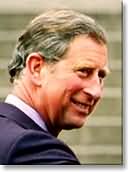
The Prince of Wales, eldest son of Queen Elizabeth II and Prince Philip, Duke of Edinburgh, is heir apparent to the throne.
The Prince was born at Buckingham Palace on 14 November 1948, and was christened Charles Philip Arthur George.
When, on the accession of Queen Elizabeth in 1952, he became heir apparent, Prince Charles automatically became Duke of Cornwall under a charter of King Edward III dating back to 1337, which gave that title to the Sovereign's eldest son. He also became, in the Scottish Peerage, Duke of Rothesay, Earl of Carrick and Baron Renfrew, Lord of the Isles, and Prince and Great Steward of Scotland.
The Prince was created Prince of Wales and Earl of Chester in 1958. In 1968, The Prince of Wales was installed as a Knight of the Garter. The Duke of Rothesay (as he is known in Scotland) was appointed a Knight of the Thistle in 1977. In June 2002 The Prince of Wales was appointed to the Order of Merit.
EDUCATION
The Prince was educated at Cheam School and at Gordonstoun, Scotland. He spent part of the school year in 1966 as an exchange student at the Geelong Church of England Grammar School, Melbourne, Australia - the first member of the British Royal family to attend an overseas Commonwealth school.
Between 1967 and 1970, the Prince read archaeology and anthropology and, for his last two years, history, at the University of Cambridge. He took an active part in undergraduate life, appearing in several college revues and gaining his University Colours ('half-Blue') for polo. In 1969 he spent one summer term in Aberystwyth at the University of Wales, before his formal investiture as Prince of Wales in Caernarvon Castle on 1 July 1969. He graduated from Cambridge with a BA (Honours) degree in 1970. The Prince took his seat in the House of Lords in the same year.
MILITARY CAREER
The Prince of Wales took up his first Service appointment in 1969 as Colonel-in-Chief of the Royal Regiment of Wales. He became Colonel of the Welsh Guards in 1975, in succession to The Duke of Edinburgh, and now holds a number of Service appointments.
In 1971 he spent six months at the Royal Air Force College at Cranwell learning to fly jet aircraft and obtaining his RAF wings.
In the autumn of 1971 the Prince entered the Royal Navy. Following service on a guided-missile destroyer and two frigates, he qualified as a helicopter pilot in 1974 at the Royal Naval Air Station at Yeovilton in Somerset. Subsequently, the Prince joined 845 Naval Air Squadron on Commando flying duties, operating from the aircraft carrier HMS HERMES.
In early 1976 he took command of the coastal minehunter HMS BRONINGTON. The Prince left the Royal Navy at the end of 1976.
He currently holds the rank of Vice-Admiral in the Royal Navy, Major-General in the Army and Air Vice-Marshal in the Royal Air Force.
MARRIAGE AND FAMILY
On 29 July 1981 The Prince of Wales married Lady Diana Spencer in St Paul's Cathedral. The marriage of The Prince and Princess of Wales was dissolved on 28 August 1996. The Princess of Wales was killed in a car crash on 31 August 1997 in Paris. In 2005, Charles married Camilla Parker Bowles, who uses the title Duchess of Cornwall.
Their two children, Prince William and Prince Henry, are second and third in line of succession to the throne.
Prince William Arthur Philip Louis was born on 21 June 1982 at St Mary's Hospital, Paddington, in London. He was christened by the Archbishop of Canterbury at Buckingham Palace.
Prince Henry Charles Albert David was born on 15 September 1984 at St Mary's Hospital, Paddington. He was christened by the Archbishop of Canterbury in December 1984 in St George's Chapel, Windsor.
ACTIVITIES AND INTERESTS
The Prince of Wales takes a keen and, where possible, active interest in all areas of public life. Each year he undertakes a large number of public engagements both in Britain and overseas - some 290 in 1997. He is associated as a patron or president with around 200 organisations, covering a wide range of interests and activities - young people, the unemployed, the disabled, the elderly, the problems of the inner cities, education, medicine, the arts, conservation, national heritage, environment, architecture and sport. Not all of The Prince of Wales' work is carried out in public. There are frequent private meetings and discussions with Government Ministers, political figures, academics, experts and the business community, through which he has access to a wide range of opinion and thinking on national and international issues.
Among The Prince of Wales's many interests, the following play a major role:
Young people
This is done particularly through the work of The Prince's Trust, of which the Prince is President. Since its inception in 1976, the Trust has helped over 33,000 disadvantaged young people set up in business. Indeed, the 100 most successful businesses supported by the Trust now collectively have a turnover of £60 million each year and employ more than 2,000 staff. The Trust has also helped over 200,000 disadvantaged young people fulfil positive ambitions for themselves or their communities through various training courses and grants, and nearly 15,000 young people have completed his Volunteers personal development programme. Almost two-thirds of the unemployed who have attended the Volunteers programme have gone on to work, further education or training.
In 1971 the Prince set up the Welsh organisation now known as The Prince's Trust 'Bro' (community) in Cardiff, to help Welsh communities, and especially their younger inhabitants, preserve their special character and cope with the environmental effects of rapid social and economic change. During the last 25 years it has supported more than 4,000 projects with nearly £4 million in grants and its field officers have worked with hundreds of community groups.
Environment
The Prince of Wales's interests in this field are also wide, reflecting his views on the common duty to care for the natural world for the benefit of future generations, and to exploit natural resources in a way which can be sustained indefinitely. Since 1970 he has promoted, through a number of major speeches, national and international debate on a wide range of issues concerning the environment, the countryside, agriculture and rural life. He also made a television programme for the BBC in 1990 on these issues, The Earth in Balance.
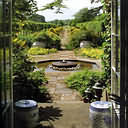
The Prince is putting his beliefs into practice by farming 1,100 acres at his home - Highgrove in Gloucestershire - organically (without using artificial fertilisers or pesticides). He has written a book about his experiences, Highgrove: Portrait of an Estate.
Business-driven community regeneration
The Prince has been at the forefront of developing corporate social responsibility in the UK. He has invited business leaders to join teams on environment, education and regeneration. Over 800 business leaders, at his invitation, have visited inner city schools and community projects as part of his 'Seeing is Believing' programme.
Education
As well as pursuing his concern for the standards and quality of education, particularly for deprived young people, through the work of The Prince's Trust, The Prince of Wales takes an active interest in educational projects: the teaching of Shakespeare (he is President of the Royal Shakespeare Company and has established a Shakespeare Summer School for teachers, run by the RSC), and the provision of scholarships for students from overseas who might not be able to afford to study in Britain. He is Chairman of the Cambridge Commonwealth Trust, and Vice-Patron of the British Council.
Architecture
The Prince of Wales's interest in the built environment and in the importance of re-establishing an integrated approach to traditional building crafts and to the involvement of the community in architecture, is well known. In 1988 he presented a major television documentary on architecture in Britain, A Vision of Britain. On Duchy of Cornwall land at Poundbury, Dorchester, he has developed an approach to building which reflects many of his concerns for the quality of life in the modern built environment. His work with the Urban Villages Forum is intended - with his other initiatives - to help create in urban developments a sense of identity and belonging among those who live in modern cities.
Heritage
The Prince of Wales is strongly committed to the preservation of Britain's national heritage. His work stretches from cathedrals to Britain's industrial heritage, townscapes and country houses. He was actively involved in the restoration of Windsor Castle. The Prince's interests include European heritage; in 1991 he and President Havel of the Czech Republic formed the Prague Heritage Fund, to help save some of the threatened architecture of the city. He is also President of the Phoenix Trust, established under his auspices in 1996 to help find new uses for important buildings whose future is threatened, for the benefit of local communities and the public at large.
As a patron of the arts, the Prince's activities include patronage of the Philharmonia and English Chamber Orchestras, the Royal Opera, the BBC National Orchestra of Wales and many choirs, musical societies, Festivals, colleges and schools. He is also an active Patron of the Association for Business Sponsorship of the Arts.
In the visual arts, he is active as Honorary President of the Royal Academy Trust, Patron of the National Gallery Trust and Chairman of the Royal Collection Trust. He also provides encouragement to young painters and craftsmen through The Prince's Trust.
Health
Although best known for his advocacy of certain recognised complementary therapies, The Prince of Wales is also a keen supporter of 'integrated' health care, believing that patients should have available to them the best of both orthodox and complementary medicine. The Prince is Patron of the Foundation for Integrated Medicine and President of the King's Fund and has been President of the Royal College of General Practitioners. As Patron of SANE, the mental health charity, and Macmillan Cancer Relief and through his work with hospices, housing and care for the elderly and the disabled, he has considerable experience across the field of health care.
OVERSEAS VISITS
The Prince of Wales undertakes a regular programme of official visits overseas, in all parts of the world. His visits combine a number of functions. They enable him to see for himself a wide range of international issues and to meet a great variety of heads of state, senior official figures and people from all walks of life who will become key figures in their own countries. He is able to use his visits to promote Britain, British interests and British business in the widest sense. His visits are also the means to pursue his working interests internationally. The Prince also occasionally represents The Queen at overseas events, such as the handover of Hong Kong in June 1997. |