Check Out Lastminute Bargain Break, short break deals and last minute holidays for hotels, b&b, inns/pubs and holiday cottage lets in and around the Cotswolds
on Accommodation

The Local Time is Monday, 12-May-2008 13:56:35 BST

COTSWOLD BLOGS -
Stow-on-the-Wold Cotswolds

Search Cotswolds.Info Website
SEARCH
CHAT
ADVERTISE
YOU ARE HERE: Main Home Page > Cotswold Blogs Stow-on-the-Wold E-mail This Page
 
Specially Chosen Cotswold Press Articles from around the World

RSS News Feed from telegraph.co.uk  This Feed is brought to you by Cotswolds.Info

Specially Chosen Cotswold Press Articles from around the World

Special interest articles about the Cotswolds published in the World Press
04/15/2007
Lords of the Manor
When I called Lords of the Manor to book the table, the French voice on the phone tactfully suggested that jeans and trainers would be inappropriate for the dining room. I couldn't agree more I'm so over jeans and trainers. A dress code that might have come across as incredibly square a year ago, suddenly sounded quite hip. Lords of the Manor is the restaurant in the hotel of the same name in the village of Upper Slaughter, near Stow-on-the-Wold. It's the quintessence of Cotswold..........
04/15/2007
England's Cotswolds Peaceful, Charming
PAINSWICK, England -- The main road through this picturesque village says a great deal about the timeless quality of the Cotswolds, a region of low, rolling hills in England's West Country. A vision of tranquil English village life, the street is lined with charming, centuries-old stone houses and a half-timbered post office that dates from the Middle Ages........
10/10/2006
The Pudding Club - A Paean To English Puddings In The Cotswolds
But, as food preferences evolve, Britain’s great puddings, even the sweet variety, were being overlooked in favor of Black Forest cake and strawberry cheesecake. In 1985, to preserve this important piece of culinary heritage, Three Ways House Hotel, a historic hotel in the low hills called the Cotswolds in the county of Gloucestershire, 90 miles from London in southwest England, established the Pudding Club. The goal: to preserve the pudding from drifting into obscurity.......
09/02/2006
The Cotswolds and beyond
What turned out to be one of our 'funnest' trip in years, unfortunately started out in a very stressful manner. But that's life. So let me tell you how it all began:
My partner Dianne Marie and I arrived at Heathrow Airport outside London, some 13 hours after leaving San Francisco. We immediately rented a car and attempted to drive to The Cotswolds. Yes, I said "attempted," because it took us forever to get there.


09/13/2006
Mindful of politics, culture in England
ED JONES is editor of The Free Lance-Star. He can be reached at 540/374-5401 or at edjones@freelancestar.com.


GLANCE AT THE stone walls inside the little old church in Sherborne, England, and you'll notice a roster of vicars who have graced the pulpit there. The list goes back 900 years.

But it was a reference of more recent vintage that caught my eye last week as I strolled around the sanctuary. A needlepoint pad for kneeling worshippers offered a simple but touching message: "God bless America. Stand beside her, and guide her. September 11, 2001."

That evening, as my wife, Peggy, and I were watching the BBC news in our rented cottage in the Cotswolds, 75 miles west of London, we heard about a survey that found that most Britons think it's time to put distance between their country and the United States in the war on terrorism.

Those sentiments surfaced as newspapers and TV reporters swarmed around the Labor Party infighting that forced Prime Minister Tony Blair, George W. Bush's most loyal and articulate ally in the post-9/11 period, to promise to step down from office within the next year. Blair, the fresh, boyish leader of the Brits a decade ago, has become stale..........

08/30/2006
Reading to avoid ignorant-American status
ED JONES is editor of The Free Lance-Star. He can be reached at 540/374-5401 or at edjones@freelancestar.com


I'M NOT PROUD of it, but I might as well confess. I recently purchased my very own copy of "British History for Dummies."

Now granted, there are many areas of expertise in which I would quickly qualify as a dummy. Plumbing and cooking are two that come to mind.

But being a dummy on British history hurts.

After all, I took a course on the Tudors in college. I subscribe to The Spectator, a weekly opinion journal from Britain that keeps me on top of politics across the pond.

I once had an electronic subscription to The Times of London. I still read an array of newspapers and magazines about the Church of England.

But as my wife, Peggy, and I prepare for a short trip to the Cotswolds, that rolling slice of England three hours west of London, I still feel like a dummy............

01/04/2006
All of Stratford's a Shakespeare stage
The Free Lance-Star


By MARY ELLEN BOTTERTHE DALLAS MORNING NEWS

Hamlet proclaimed, "The play's the thing."

The Royal Shakespeare Company will prove that's true.

The troupe is sponsoring a yearlong festival at Stratford-upon-Avon, William Shakespeare's hometown, at which all of the Bard's 37 plays plus his sonnets and long poems will be performed.

It will be the first time that all of the works will be presented in a single event.

The festival will open on Shakespeare's birthday, April 23, and continue into April 2007..............

05/26/2002
Walk Along River Thames Left Indelible Impressions
After spending the better part of last month in England, walking along the River Thames, a few random observations (mostly ecologically inspired) seem in order this week. So, with a tip of the hat to author Bill Bryson, who was encountered out there in a Cotswold field, here are some of my own "notes from a long, long river.".......


ARTICLES BY RALPH GREEN OF THE VISITOR INFORMATION CENTRE AT STOW-ON-THE-WOLD

Morris Dancers - August 2007

Stow on the Wold - March 2007

Deserted Cotswold Villages - September 2006

Cotswold Place Names - July 2007

The Battle of Stow-on-the-Wold 1646 - April 2006

Tracks and Roads across the Cotswolds - October 2005

The Cotswold Lion - May 2005

An Early Cotswold Visit - January 2005

The History of Bourton-on-the-Water - September 2004

Cotswold Roofs - April 2004

Cotswold Dry Stone Walls - February 2004

Cotswold Ridge and Furrows - October 2003

The Rollright Stones - June 2003

The Gypsy Horse Fair at Stow-on-the-Wold - March 2003

The Cotswolds - In the Beginning - February 2003

Get the XML feed for these Cotswold Blogs Cotswold Blogs
Cotswolds RSS Blogs

Add to Google

AddThis Feed Button

Ralph Green

Ralph Green lives in Bourton-on-the-Water and used to work for many years at the Stow-on-the-Wold Visitor Information Centre

For more Cotswold Articles:-

Stow-on-the-Wold


Visitors to Stow-on-the-Wold call in at the Tourist Information Centre for a chat, buy postcards, maps and walking books. Many visitors ask about the town and its lovely old square and want to know about its history and what helped to create such interesting architecture.

In fact, so many people asked similar questions, we decided to produce a tri-fold leaflet containing old photographs that tried to tell Stow’s story in a simple way. It was nice to be able to give something out to visitors and I am sure it was nice for them to take away a small reminder of their visit.

Stow-on-the-Wold is an ancient Cotswold Wool Town situated beside The Fosse Way, a Roman road that runs from Exeter to Lincoln in an almost straight line. It is set on a rounded hill at a height of about 800 feet above sea level. This elevated position, and the effects of the wind and rain have encouraged the creation of the enclosed town square. Keeping the winter winds out of the town centre does, to certain extent, seem to work.

Iron Age people were the first to settle on the hill but there is evidence of earlier settlements in this part of the Cotswolds. Stone Age and Bronze Age burial mounds are common throughout the area.

There is a strong tradition that in Saxon times a missionary named Edward lived as a hermit at the well on the south side of the town. This helped to establish the first name of the town as St. Edward's Stowe or Holy Place. The word 'wold' as in Cotswold means hills, so Stow-on-the-Wold simply means Holy Place on the Hill.

The houses of Stow were built with the mellow Cotswold limestone from local quarries. Some have massive internal oak beams from the days when Gloucestershire was covered in forest. Many of the houses were built in the 16th century and those built later have blended in to become part of the character of this beautiful town, a place that has evolved over some 500 years.

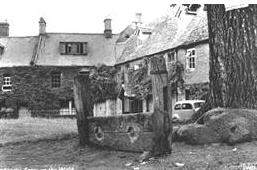
One of the oldest houses, the 'Crooked House' on the west side of the Square, was built about 1450. The Kings Arms is a good example of a coaching inn where the main entrance was through the arch leading to the stables. Charles I stayed here about the time of the Battle of Naseby in 1645. On Digbeth Street stands the Royalist Hotel, said to be the oldest inn in England. An inn has stood on this site since 947AD. The stocks on the green are the latest in a long line dating back to the 15th century.
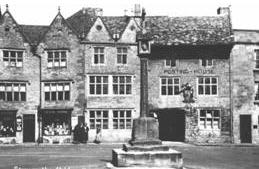
The Kings Arms and Market Cross at Stow on the Wold Stow stocks
The Kings Arms and Market Cross The Stocks

In March 1646, the last important battle of the Civil War ended in the Square. The Parliamentary army under the command of Colonel Morgan overwhelmed Sir Jacob Astley's Royalist army. 1000 prisoners were held in the parish Church while the wounded were laid in Digbeth Street. It is said the street ran with blood. To remember those who fought and died at this time, a memorial stone was placed in St. Edward's churchyard in 1992.

Stow was, until recent times, supplied with water from springs below the town. For centuries, women and children had carried water with yoke and bucket from the spring on Well Lane. Water carts plied between Well Lane and the town where the water was sold to the townsfolk at the price of a farthing a bucket. Several systems had been tried to force water up the hill including windmills, horse-mills and water wheels but all had failed. In 1871, Joseph Chamberlayne-Chamberlayne, lord of the manor, donated £2000 to the town for a deep well to be bored and this was a success. Mains water was laid on in 1937. Sewage disposal used numerous cavities in the rock, known locally as swillies, as natural soakaways under and around the houses until mains drainage was installed in 1958.
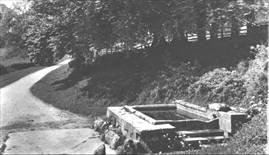
Spring on Well Lane Stow-on-the-Wold
Spring on Well Lane

In 1476, Edward IV gave a charter to the town authorising two fairs, the first on the 12 May, the other on the 24 October. Over 500 years later these dates are still used to fix the two horse fairs held each year. The town's main source of wealth at that time was wool, and sheep from the surrounding hills and villages were brought to the fairs in the Square where it is said that as many as twenty thousand sheep were sold on a good day. The narrow alleyways called 'tures' leading from the Square to the perimeter of the town were constructed for the better control of animals. The Market Cross was erected as a symbolic reminder to the traders of medieval times to deal honestly and fairly. The shaft, base and steps are medieval but the gabled headstone is an addition restored by public subscription in 1995. The side panels depict the Crucifixion, Edward the Confessor, the Civil War and the Wool Trade. The gipsy horse fair is, by tradition, held on the nearest Thursday to the two Charter days.

St. Edward's Hall stands in the Square, built in 1878 from unclaimed deposits placed in the Town Saving Bank. As well as providing the town with a meeting place, it also houses the library. A figure of St. Edward stands in a niche over the main entrance. The steeple, called a bell-turret, was constructed to accommodate a bell used to summon the fire brigade.
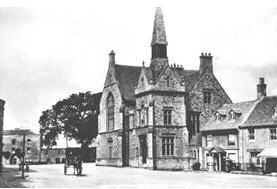
St. Edwards Hall at Stow
St. Edward’s Hall

The Parish Church of St. Edward was built between the 11th and the 15th century. The tower was the last part of the church to be completed in 1447. It is 88' high and houses the heaviest peal of eight bells in Gloucestershire; it is also very prominent for miles around. The painting of the Crucifixion in the south aisle was painted by Gaspar de Craeyer (1582 - 1669), a contemporary of Rubens and Van Dyck. Many features of this outstanding Cotswold Church may be attributed to the town's prosperity as a centre of the Wool Trade.
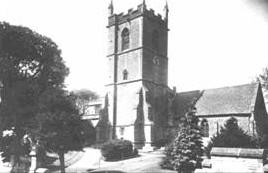
St Edwards Parish Church at Stow
St Edwards Parish Church

Today Stow-on-the-Wold draws people from all over the world. It used to be that the winter months were very quiet, but during my time at the Visitor Information Centre, we noticed increasing numbers coming no matter what the season. People come just to walk about the square, the narrow lanes and the tures, to visit the many antique shops, to take afternoon tea in one of the old teashops and get a feel for the ambience of this lovely old town. Put simply, it is a nice place to visit.


USE GOOGLE'S POWERFUL ENGINE TO SEARCH
COTSWOLDS.INFO  WEBSITE
Google
 
www.cotswolds.info - The World's largest Internet resource for the Cotswolds

Stow on the Wold

This page last modified Wednesday, 30-Apr-2008 07:40:35 BST